





Hello everyone! Welcome to our series on small business CGT concessions. Over the next three parts, we’ll be diving into the practical details of these concessions, but for now, let’s start with a quick summary.
The Australian Taxation Office (ATO) offers CGT concessions specifically designed to assist small businesses. These concessions aim to reduce the capital gains tax payable when selling or transferring assets, allowing small business owners to maximise their profits.
In our series, we’ll cover four main concessions (and a bonus concession which is not as commonly known).
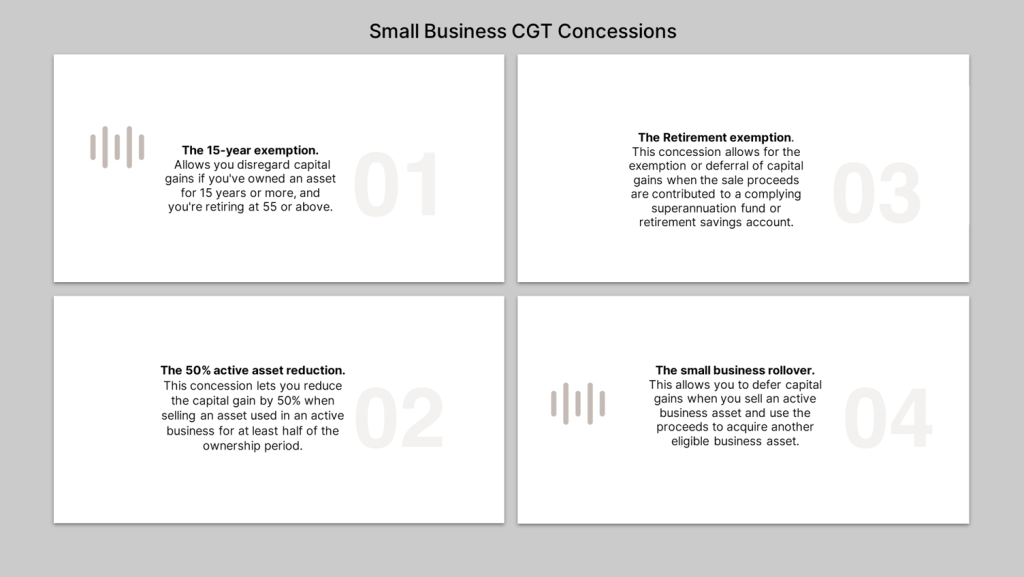
Firstly, there is the 15-year exemption, which allows you to disregard capital gains if you’ve owned an asset for 15 years or more, and you’re retiring at 55 or above.
Next up is the 50% active asset reduction. This concession lets you reduce the capital gain by 50% when selling an asset used in an active business for at least half of the ownership period.
Then we have the retirement exemption. This concession allows for the exemption or deferral of capital gains when the sale proceeds are contributed to a complying superannuation fund or retirement savings account.
The fourth concession is the small business rollover, which allows you to defer capital gains when you sell an active business asset and use the proceeds to acquire another eligible business asset.
Similarly, but separately is the small business restructure roll-over. This is principally designed to address circumstances where entities transfer active capital gains tax assets between eligible restructuring entities without tax liabilities.
In our next instalments, we’ll explore each of these concessions in more detail, providing examples and insights to help you navigate the complexities effectively. We’ll delve into the specific requirements and eligibility criteria, empowering you to make informed decisions.
So, stay tuned for the next part of our series, where we’ll discuss the 15-year exemption, active asset reduction, and retirement exemption in greater depth. We’re excited to share this valuable information with you. Remember, for comprehensive guidance, always refer to the ATO’s resources or consult a tax professional.